Revenue enablement is a process-based enablement approach to acquiring, growing, and retaining customers by aligning marketing, sales, and customer success under shared processes, metrics, and governance. Led by the CRO and partnered with RevOps, it delivers consistent, measurable buyer experiences across the entire lifecycle. Unlike sales enablement, which focuses primarily on empowering sellers, revenue enablement spans the full go-to-market engine and prioritizes adoption, cross-functional collaboration, and outcomes. If you lead Marketing, Sales, CS, or Operations — or are a CRO seeking predictable growth — this guide explains revenue enablement vs sales enablement, why it matters, and how to implement it effectively.
“Revenue Enablement is the process by which you most efficiently acquire and maintain customers, maximizing revenue gained through each stage of a customer’s journey with your business by focusing on the delivery of great customer experiences.“
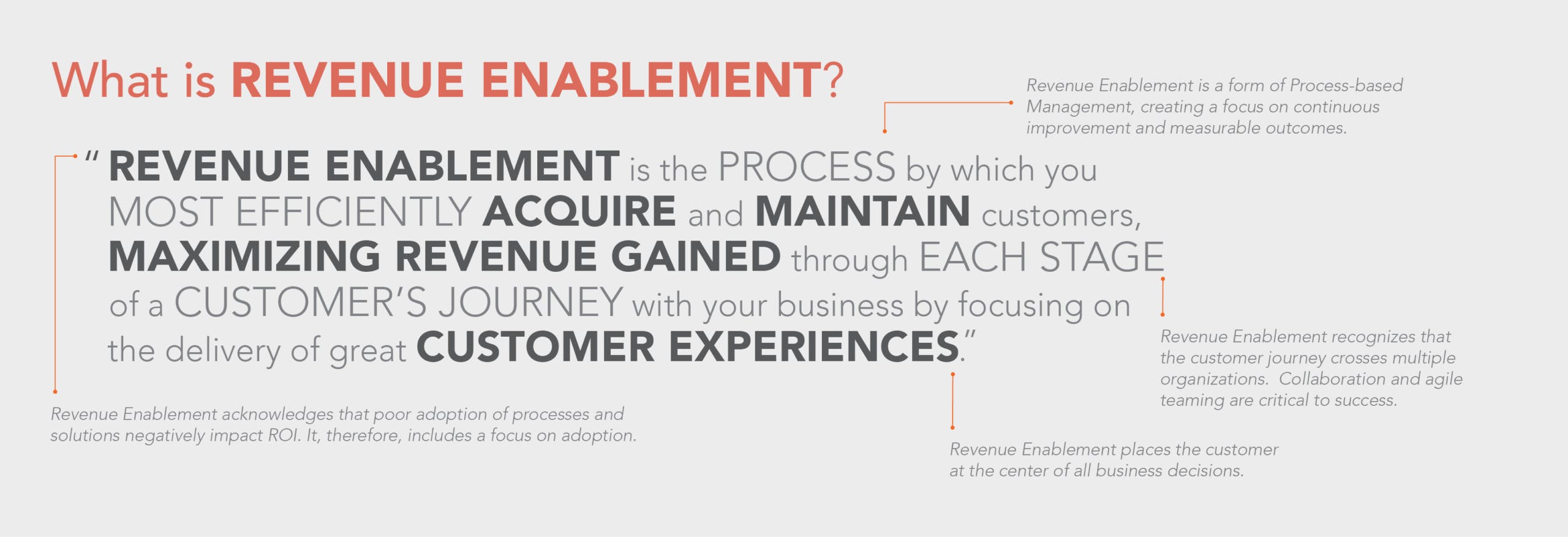
The processes are the critical components of the definition; the tools and methodologies are only supporting pieces.
Let’s briefly review the five primary tenets of Revenue Enablement:
- Customer Experience
- Process Driven
- Collaboration and Alignment
- Metrics-Oriented
- Adoption-Focused
Revenue Enablement is a parallel function to Revenue Operations, and both typically report to the Chief Revenue Officer (CRO). Revenue Enablement covers Marketing, Sales, and Customer Care. Sales Enablement is an area that exists within Revenue Enablement.
“Our research proves it over and over – organizations that maintain a focus on alignment achieve up to 19% faster revenue growth and up to 15% higher profitability.”
Revenue enablement compared to sales enablement
Sales Enablement teams are focused on creating content and training for their sellers. Often, the only measurement of success comes in the form of kudos from the sellers. The feels-good, must-be-good, approach is far too often the only data point teams are using. Yes, you may be delivering incredible value as measured subjectively (e.g., your sales team is happy and telling management). It is not enough.
Are you struggling to achieve measurable results with your sales enablement efforts? Are you struggling to deliver results that you are proud to share with the CFO?
While sales enablement remains a critical function, something with a broader scope is going to be needed. Revenue enablement is where many organizations are starting to focus their investment dollars.
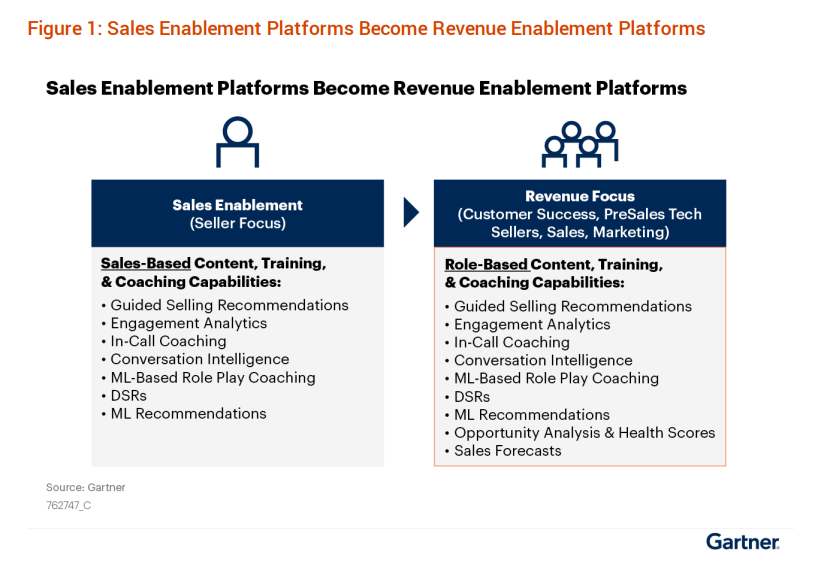
Graphic from The 2022 Gartner® Market Guide for Revenue Enablement Platforms
Difference between revenue enablement and sales enablement approaches
Scope
Sales Enablement: Equips sellers with content, training, and coaching to run effective conversations.
Revenue Enablement: Aligns marketing, sales, and customer success on shared processes and metrics across the entire customer lifecycle.
Ownership
Sales Enablement: Often led by sales/enablement leadership.
Revenue Enablement: Typically owned by the CRO; operated in parallel with RevOps for data, tooling, and governance.
Operating model
Sales Enablement: Programs and playbooks for reps; success often measured via seller feedback and activity adoption.
Revenue Enablement: Process-first, with formal governance, adoption targets, and cross-functional working groups.
Metrics
Sales Enablement: Content usage, certification completion, call scores.
Revenue Enablement: Process cost/value/adoption, win rate, deal velocity, ACV, CAC, GRR/NRR, churn.
Buyer experience
Sales Enablement: Improves sales interactions.
Revenue Enablement: Orchestrates consistent, personalized experiences across awareness, evaluation, onboarding, renewal, and expansion.
Technology
Sales Enablement: Content hub, LMS, coaching tools.
Revenue Enablement: Adds buyer engagement (digital sales rooms), conversation and relationship intelligence, advanced analytics, and integrations/Open API.
Unfortunately, most Revenue organizations fail to collaborate in any formal manner around any specific outcome. As CSO Insights Analyst Tamara Schenk shared in an article focusing on collaboration in Sales Enablement, most collaboration is ad hoc. Based upon her research, 61.2% of Enablement teams currently collaborate in an ad hoc or informal way.
Revenue Enabled organizations are process-based organisms. The team identifies each of the key processes in the Revenue Engine and:
- Define who owns the process, in its entirety, from beginning to end.
- Defines the current process, step by step, across functional team boundaries.
- Defines all stakeholders across all functional boundaries.
- Defines the cost of the process in both time and dollars.
- Defines the value created by the process in terms of revenue achieved, churn reduction, or cost savings to the business across teams.
- Defines adoption levels (see tenant number two below).
From here, a working group is formed of the key stakeholders, led by the process owner, to identify if there are inefficiencies in the process and the impact of those items to either the value created or the cost of the process.
Each process is evaluated and process improvements are prioritized based upon either the increased value or reduced costs created.
It is important to note that traditional Sales Enablement areas are included in this analysis. Teams must remain focused on delivering content and training that moves the revenue needle in a measurable manner and that results in more productive sellers.
A focus on the adoption of processes through governance, iteration, and a focus on ease of implementation
Too often, processes are developed in a vacuum. No collaboration during process design leads to no adoption of the new process.
The adoption rate of all processes, and the tools that support them, are factored into Revenue Enablement. If a Revenue-related process has clearly defined outcomes (cost, value), but is not fully adopted, money and time are being wasted. No business can afford to waste either.
The process-based management approach that drives Revenue Enablement measures adoption as a key component of all efforts. While it is rare to achieve 100% adoption of anything, must measure against this target to maximize your outcomes.
A focus on actions that lead to measurable outcomes
All processes are measured for cost versus value returned. Process optimization, driven by real data, data that includes a focus on adoption, leads to real success.
Mostly, yes. Process-based management does not require a change to organization hierarchies but does require a shift in mindset for many organizations. It allows businesses to focus on the processes, measure their impact, and cut through organizational barriers.
It is exactly what is needed support the tenets of Revenue Enablement.
Let’s review the benefits of Process-Based Management as revenue enablement, done well, will achieve these.
See also: Why investing in revenue enablement could be your most profitable move as CFO
Revenue enablement fosters continuous improvement of processes
A focus on process identification, documentation, analysis, and measurement ensures everyone in the organization understands what processes are in use and why. It exposes these processes for review to ensure mistakes and bottlenecks are quickly identified and fixed.
Revenue enablement supports cross-functional alignment
All customer-facing teams, all members of the Revenue Engine, must be part of the process improvement process. This reinforces alignment, partnership, and collaboration.
Revenue enablement focuses on business outcomes
While individual processes are being improved, they are always improved as part of the overall customer journey, not in isolation. This maintains a focus on business outcomes, not the tactics used to achieve these outcomes.
Sales Enablement has provided an excellent starting point. While it has primarily focused on content, training, and coaching, it has been evolving to look at marketing and sales alignment and process improvement.
It is leading towards overall revenue enablement.
In many ways, the tenets of revenue enablement provide us with the path to follow.
However, as with sales enablement, first, build your revenue enablement charter.
Your revenue enablement charter is a blueprint; it’s a guide for the revenue enablement leader. It outlines their mission, vision, and value to the organization. For it to be of value, include items such as:
- What are the teams being supported by revenue enablement?
- Who are the key stakeholders from all teams that provide input to, our receive the outputs of, your efforts?
- How will the team be funded?
- How will enablement efforts be measured? Revenue enablement requires defined methods for measuring outcomes and adoption.
- What are the risk factors to successful Enablement?
Remember, a charter is just a blueprint. It helps you ask and answer critical questions to understand your scope, audience, mission, risks, and key to success. It doesn’t have to be big and daunting. It can be simple and easy.
Revenue enablement focuses on process improvement
At this point, you have your charter in place, how do you get started?
- Identify all the products and services your business sells.
- Sit down with each member of the revenue leadership team (i.e., Marketing, Sales, Customer Care, Finance, Product, etcetera) individually.
- Ask each member of this team:
- What does your organization do whenever a new product or service is released?
- What does your team do whenever a product or service is updated?
- What are the most significant pain points for their team during these processes?
- How do you measure the cost/value of these activities on their teams?
- Are there things that they feel they should not be doing?
- Are there things they feel they should be doing?
- Pull all of your notes together to create an inventory spreadsheet for all processes you identify.
- Create a workflow diagram showing all activities from product release/update through the lifetime of the customer. Include buyer awareness activities, procurement, onboarding, and offboarding. You want to capture the entire revenue engine flow.
- Review with your leadership team; have you have missed anything. Review the lessons you have learned:
- Key processes
- process improvement opportunities
- Current costs
- Current adoption of methods and tools
- The current value of all of these efforts
- Recommendations on the priority order of improvement for existing processes
- Get the team’s sign-off on the initial process improvement areas.
Revenue enablement is focused on measurement and ensuring that your efforts deliver positive outcomes for your business.
Adoption of processes and tools are critical as unused processes add no value.
It is crucial to think about the other metrics in three tiers.
Direct measures
Revenue enablement is process-based. The direct measurements are easy to identify:
- Process Cost
- Process Value
- Process Adoption Rate
The second level of metrics are those impacted by improving first-level metrics. These include:
- Deal Velocity
- Win Rate
- Average Customer Value
The top-level metrics focus on revenue. These are the metrics that you will share with Executives to demonstrate the value of investing in enablement. Consider these:
- Revenue from new customers, year to date
- Cost to acquire new customers, year to date
- Revenue from new customers, year to date
- Cost to acquire new customers, year to date
- Revenue lost due to customer churn, year to date
By turning the gears of revenue engine, via revenue enablement, you make discrete and measurable changes. These adjustments lead to efficiencies in acquiring and maintaining customers and maximize the Revenue you achieve through each stage of a customer’s journey with your business.
Get the deep dive in The Definitive Guide to the Most Important Sales Enablement Metrics
Revenue enablement during the initial purchase
From the time the buyer recognizes a business problem, preferably before, your marketing team is working to grow awareness. Every touchpoint that interacts with these potential customers, regardless of channel and source, must be optimized. Each touchpoint must provide consistent messaging, great experiences, and move them closer to buying your solutions.
When your sellers finally interact with the prospect, they do so with clarity about earlier buying signals. The salespeople are prepared to take the buyer on the next step of the journey, not back to square one.
See also: The best sales touchpoints to improve your buyer’s journey
Revenue enablement during the renewal
Long before a customer is due to renew, your business should know their intentions. Are they using your solutions? Has usage decreased? Are you helping them solve the business problems they had when they bought the solution? If their business problems have changed, have you kept up with this change and continued to help them?
All of this information, from solution usage, through NPS scores, through direct feedback from your Customer Care teams, must be captured. You need this data available to analyze and determine how you continue to deliver value to your customers.
Renewals conversations should not include surprises.
Revenue enablement during the upsell
As discussed above, you need to know how your current customer experience is going. You also need to continue to monitor intent signals. Ensure your sellers and customer care teams recognize new or changing business problems directly or indirectly through these signals.
Never miss an opportunity to help your customers solve additional business problems.
Revenue enablement FAQs
What is Revenue Enablement?
Revenue Enablement aligns marketing, sales, and customer success around process-driven programs that improve buyer experience and revenue outcomes across acquisition, renewal, and expansion.
How is Revenue Enablement different from Sales Enablement?
Sales Enablement focuses on sellers’ content, training, and coaching. Revenue Enablement spans all revenue teams (marketing, sales, CS), is process- and adoption-focused, and ties directly to lifecycle metrics like CAC, win rate, and churn.
Who should own Revenue Enablement?
Most organizations place Revenue Enablement under the Chief Revenue Officer (CRO) and operate it in parallel with Revenue Operations for governance, data, and tooling alignment.
What are the core tenets of Revenue Enablement?
Customer experience, process-driven design, cross-functional alignment, metrics orientation, and adoption governance.
How do you measure Revenue Enablement?
Measure at three levels: process (cost, value, adoption), commercial (win rate, deal velocity, ACV), and financial (new/expansion revenue, CAC, churn/GRR/NRR).
What tools support Revenue Enablement?
Content management, readiness/coaching, buyer engagement (e.g., digital sales rooms), AI, conversation and relationship intelligence, analytics, and integrations/Open API.
How fast can we implement Revenue Enablement?
In 90 days you can launch a charter, map core processes, stand up governance, and ship high-impact pilots that improve adoption and measurable outcomes.