
You don’t need a PhD in dashboards anymore.
Or a direct line to your overworked data science team, who’s probably too busy building machine learning models to answer whether your Q3 training moved the needle.
Why? AI assistants are finally smart (and simple) enough to help sales, enablement, and marketing leaders get real answers from all their analytics — without needing a data team or technical skills.
With natural language querying built into some AI assistants, you can:
- Ask direct questions about your content performance
- Get instant insights from training and sales engagement data
- Skip the three-week wait for custom reports
Want to know which materials show up most in closed-won deals? Just ask. Curious about whether that expensive certification program correlates with quota attainment? Ask away.
The problem is that most enablement leaders are stuck between two worlds:
- You need to prove impact to executives who want numbers yesterday.
- You also want to improve your strategy in real-time without playing the telephone with analysts or building pivot tables at midnight.
Plain-language AI assistants remove those roadblocks entirely. In this article, we’ll explain what enablement analytics AI is, how it helps, and how to use it to get better answers.
But first, what is an ‘enablement analytics AI’ tool?
Enablement analytics AI uses artificial intelligence to interpret your sales, content, and training data through natural conversation. You ask questions in plain English, and it delivers answers in seconds. You don’t have to wrangle the data yourself using SQL or pivot tables (thank god!).
Think of it as your personal universal translator — but instead of converting Klingon to English, it translates your business questions into data insights.
The magic happens in three steps:
- Natural language input: “Which content helps enterprise reps close deals fastest?”
- AI processing: The system analyzes usage patterns, win rates, deal velocity, and content engagement across your entire data ecosystem.
- Instant insights: “Enterprise reps using the ROI calculator demo in their final presentations close deals 23% faster than those who don’t.”
Unlike traditional analytics platforms that dump raw data on your desk and wish you luck, these AI assistants understand context. They know the difference between correlation and causation. They can spot patterns across thousands of interactions that would take your team weeks to uncover manually.
Best of all, it’s conversational and explainable. You can ask follow-up questions. Drill down into specifics and the AI shows its work, citing exactly which data points informed each insight.
You don’t have to deal with black-box mysteries where you’re not sure if the recommendation came from solid analysis or digital wishful thinking.
What are the 3 areas where enablement analytics AI can make you smarter?
Here are three functions where enablement analytics AI shines:
1. Content performance for marketing and enablement teams
Your content library has 847 assets. Your reps use maybe 12 of them regularly. Which ones correlate with closed-won deals?
Traditional approach: Export usage reports from three different systems. Cross-reference with CRM data and build pivot tables.
AI approach: “Which content is most used by top-performing reps in the last 60 days?”
The AI instantly surfaces patterns you’d never catch manually.
Maybe your beautifully designed product brochures get lots of downloads but rarely appear in winning deals. Meanwhile, that scrappy one-pager your best rep created shows up in 78% of enterprise closes.
Also, advanced AI systems can even identify content gaps. They’ll tell you exactly what questions prospects are asking that your current materials don’t answer.
For example, if you notice that reps constantly ask a question like “How does XYZ integration work?” and they’re getting a zero-hit search, that’s a gap you need to fill.
Some systems track the content journey — from rep discovery to buyer engagement. You can see which materials get shared but ignored versus which get multiple views and drive follow-up meetings. And that’s how you know which assets are making a high impact.
💡 Example prompts you can try today:
- “Show me content that appears in 80%+ of deals over $100K”
- “Which assets have the highest view-to-close conversion rates?”
- “What materials do enterprise reps share most in final presentations?”
- “Which content gets multiple views from the same prospect before closing a deal?”
- “What’s the difference in content usage between won and lost deals?”
2. Sales and buyer engagement for enablement and RevOps teams
Buyer behavior is like a crime scene. There are clues everywhere, but you need the right detective skills to piece together what happened. I mean, we’ve all seen this Gartner infographic:
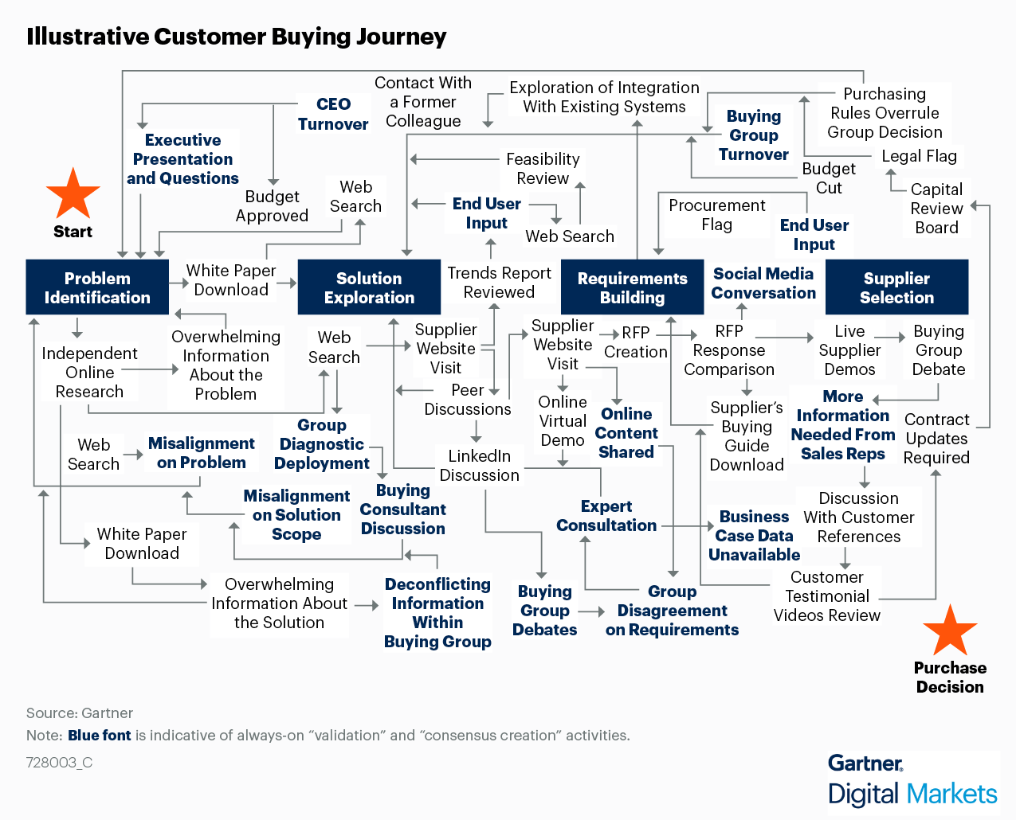
Let’s say you ask a question like, “What sales materials were shared in closed-won deals last quarter?” It’ll show you a pattern in your enablement data, such as pricing deck or case study performance.
The best AI systems track engagement at a granular level. They know which slides in your presentation get the most attention. Which sections of your proposals get highlighted or commented on? Even which questions prospects ask about your shared content in digital sales rooms. This level of insight transforms how you approach each deal.
Instead of generic follow-ups, you can reference specific sections that resonated. “I noticed you spent extra time on our security framework slide — would you like me to connect you with our CISO for a deeper dive?”
You can also identify behavioral patterns that predict deal outcomes. Maybe prospects who engage with your ROI calculator within 48 hours of the first demo are 3x more likely to close. That pattern becomes a playbook for your entire team.
💡 Example prompts you can try today:
- “Which content generates the most follow-up questions from prospects?”
- “What materials get shared most often in the final 30 days before close?”
- “Show me buyer engagement patterns for deals over $250K”
- “Which case studies perform best with C-level stakeholders?”
- “What content correlates with shorter sales cycles?”
3. Sales learning & training analytics for enablement and L&D teams
Many enablement teams struggle to connect L&D activities to real business outcomes, but are being tasked more and more with doing so.
The ability to just ask AI questions like, “Which reps completed product training and hit quota within 90 days?” is a game changer.
AI analytics tools can track and correlate completion rates, competency development, and skill application. If you notice that a rep finishes 78% of their training and is closing more deals in Q4, that’s a signal.
You can quickly discover your expensive external training program has zero correlation with performance, while peer coaching sessions drive measurable results — and now you know where to focus your efforts next time.
You’ll also discover which training formats work best for different learning styles and experience levels.
This way, you can build training programs that work for your entire team — a mammoth task.
💡 Example prompts you can try today:
- “Show me the training completion rate for quota-achieving reps vs. non-achievers.”
- “Which coaching activities correlate with faster ramp times?”
- “What’s the ROI of our certification programs by region?”
- “Which roleplay scenarios best predict real-world success?”
- “How does manager coaching frequency impact deal velocity?”


Plain language prompts change how you interact with your data — here’s how:
You don’t have to build reports or wait for analysts
There was a time when getting a simple “which content performs best” answer required a project timeline. You’d submit a request, wait for an analyst to get back to you, clarify things, and then tell you what’s happening.
However, 46% of organizations don’t use data to gain insights or make critical decisions. Why? Because they don’t consider data to be a strategic asset. And we get it. You look at a dashboard, and all of a sudden, you’re wondering if all those numbers matter.
Plain language AI makes it easier to get that answer. You can ask questions as they occur to you.
For example, during a sales meeting, someone mentions, “I wonder if our new pricing deck is actually working.” All you have to do is ask the AI to analyze your data and give you the answer in seconds.
You can bridge the “sales experience” gap
Most enablement professionals have never closed an enterprise deal. That knowledge gap creates blind spots in your strategy — you’re building training for a world you’ve never experienced firsthand.
According to the Sales Enablement Collective’s 2024 report, 39% of enablement teams cite “lack of formal, internal alignment on what enablement is or does” as their biggest challenge.
Translation: even internal stakeholders aren’t sure what you should do.
AI analytics becomes your bridge to frontline reality.
Instead of guessing what matters, you can ask your data what top performers do.
The AI surfaces patterns from thousands of successful interactions — like having every quota crusher’s playbook distilled into actionable insights. And you can use that to align on training needs that directly impact business outcomes.
You can reduce noise and bias in important decisions
According to Forrester’s 2024 Marketing Survey, poor data quality, poor data accessibility, and lack of clarity about business goals stand in the way of progress. These challenges haven’t changed from the previous year — meaning they’re persistent and require focused effort to solve.
You think your Q3 content refresh drove better win rates. But correlation isn’t causation. AI helps you test for incrementality: “When reps increase usage of the new pitch deck does quota attainment improve, irrespective of other factors?”
That’s how far you drill down into your data.
You can empower your team to use real data
According to Sales Enablement Collective, 25% of enablement teams use AI regularly, with another 55% making occasional use. But most organizations still treat data analysis as a specialized skill reserved for analysts and data scientists.
Plain language AI democratizes data access across your entire team. For example:
- Sales leaders can ask “Which coaching activities correlate with faster ramp times?” without submitting a help desk ticket.
- Marketing leaders can query “What questions are prospects asking that our current materials don’t answer?” during their weekly planning sessions.
- Enablement leaders can ask, “How many reps are closing more deals as they complete more than 75% of their training sessions?”
It helps your team go from data consumers to data explorers.
That’s how you build a culture of evidence-based decision making.
3 tips for getting better AI answers about your enablement data
The difference between getting basic AI responses and game-changing insights comes down to how you ask questions. Here’s how you can do that:
1. Ask outcome-focused questions
With 72% of organizations now using AI in at least one business function — up from 55% just last year — the companies getting real value are those asking business questions, not technical ones.
Instead of: “How many people completed training?”
Ask: “Which reps completed product training AND hit quota within 90 days?”
Follow-up: “What’s different about the training path of quota-achievers vs. non-achievers?”
The first question tells you about compliance. The second reveals what drives performance.
2. Add more filters and context
AI adoption has surged, but according to BCG research, 74% of companies struggle to achieve and scale value from AI. The reason? They’re not asking contextual questions that drive business decisions.
Here are a few examples:
- Time filters: “In the last 90 days…” “Since the new product launch…”
- Segment filters: “Among enterprise reps…” “In the EMEA region…”
- Persona filters: “For prospects in financial services…” “Among decision-makers vs. influencers…”
- Product/service filters: “For XYZ product…”
3. Layer your questions and follow-up
McKinsey research shows that 71% of organizations use generative AI in at least one business function. The leaders are those who’ve learned to have conversations with their data, not just extract reports.
First layer: “What content has the highest engagement?”
Second layer: “Of that high-engagement content, which pieces appear most often in closed-won deals?”
Third layer: “What’s the optimal timing for sharing these high-converting assets in the sales cycle?”
Most teams stop at layer one and wonder why their analytics don’t drive results.
Take advantage of enablement analytics AI — and get answers to the questions that matter
AI assistants have made enablement analytics radically more accessible.
If you can ask it, you can know it. And knowing — really knowing what drives performance in your organization — changes everything.
If your current system makes it hard to ask simple questions like “Which training correlates with quota attainment?” It might be time to consider something built for AI from the ground up.
Your data has always had the answers. Now you finally have the translator to unlock them. Let us show you how that works. Book a demo with us today.